

5 12 To A Decimal
| GMT at page generation (last updated 24 October 2022) ( ) | |
|---|---|
| 24-60 minutes time | Decimal time |
| 12:42:38 | 5:29:60 |
| 5h 29k 60s | |
| 0.52960 d | |

French decimal clock from the fourth dimension of the French Revolution. The big dial shows the ten hours of the decimal twenty-four hours in Standard arabic numerals, while the small-scale dial shows the two 12-60 minutes periods of the standard 24-hour day in Roman numerals.

Decimal-time clock reading 2.fifty DT equivalent to 06:00 standard time
Decimal fourth dimension is the representation of the time of day using units which are decimally related. This term is oft used specifically to refer to the time organization used in France for a few years beginning in 1792 during the French Revolution, which divided the day into 10 decimal hours, each decimal hour into 100 decimal minutes and each decimal minute into 100 decimal seconds ( 100000 decimal seconds per day), equally opposed to the more familiar UTC time standard, which divides the day into 24 hours, each hour into 60 minutes and each infinitesimal into 60 seconds ( 86400 SI seconds per twenty-four hours).
The main advantage of a decimal time organization is that, since the base used to divide the time is the aforementioned equally the 1 used to stand for it, the whole time representation tin be handled as a unmarried string. Therefore, information technology becomes simpler to translate a timestamp and to perform conversions. For instance, 1:23:45 is 1 decimal hour and 23 decimal minutes and 45 decimal seconds, or one.2345 decimal hours, or 123.45 decimal minutes or 12345 decimal seconds; 3 hours is 300 minutes or 30,000 seconds. This belongings also makes it straightforward to represent a timestamp as a fractional day, so that 2022-10-24.54321 tin can exist interpreted every bit five decimal hours and 43 decimal minutes and 21 decimal seconds afterwards the commencement of that day, or a fraction of 0.54321 (54.321%) through that day (which is before long after traditional 13:00). It also adjusts well to digital time representation using epochs, in that the internal time representation tin can be used directly both for computation and for user-facing display.
| decimal | 24-60 minutes | 12-hour |
|---|---|---|
| 0 (Midnight) | 00:00 | 12:00 a.m. |
| i | 02:24 | two:24 a.m. |
| ii | 04:48 | four:48 a.m. |
| three | 07:12 | seven:12 a.thousand. |
| 4 | 09:36 | nine:36 a.m. |
| 5 (Noon) | 12:00 | 12:00 p.m. |
| 6 | xiv:24 | 2:24 p.g. |
| 7 | 16:48 | 4:48 p.chiliad. |
| 8 | xix:12 | 7:12 p.m. |
| ix | 21:36 | 9:36 p.m. |
History [edit]
China [edit]
Decimal time was used in Cathay throughout nigh of its history alongside duodecimal time. The midnight-to-midnight mean solar day was divided both into 12 double hours (traditional Chinese: 時辰; simplified Chinese: 时辰; pinyin: shí chén ) and also into ten shi / 100 ke (Chinese: 刻; pinyin: kè ) by the 1st millennium BC.[ane] [2] Other numbers of ke per day were used during three brusque periods: 120 ke from five to 3 BC, 96 ke from 507 to 544 CE, and 108 ke from 544 to 565. Several of the roughly 50 Chinese calendars besides divided each ke into 100 fen, although others divided each ke into sixty fen. In 1280, the Shoushi (Season Granting) calendar further subdivided each fen into 100 miao, creating a consummate decimal fourth dimension organisation of 100 ke, 100 fen and 100 miao.[iii] Chinese decimal time ceased to be used in 1645 when the Shíxiàn calendar, based on European astronomy and brought to Mainland china by the Jesuits, adopted 96 ke per mean solar day alongside 12 double hours, making each ke exactly one-quarter hour.[iv]
France [edit]
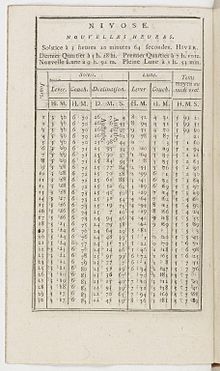
Astronomical table from the Almanach national de France using decimal time
In 1754, Jean le Rond d'Alembert wrote in the Encyclopédie:
- Information technology would be very desirable that all divisions, for example of the livre, the sou, the toise, the mean solar day, the hr, etc. would be from tens into tens. This segmentation would result in much easier and more user-friendly calculations and would exist very preferable to the capricious segmentation of the livre into twenty sous, of the sou into twelve deniers, of the day into mean solar day, the hour into sixty minutes, etc.[v] [6]
In 1788, Claude Boniface Collignon proposed dividing the day into 10 hours or 1000 minutes, each new hour into 100 minutes, each new minute into thousand seconds, and each new second into 1000 tierces (Latin for "third"). The distance the twilight zone travels in one such tierce at the equator, which would be one-billionth of the circumference of the earth, would be a new unit of length, provisionally called a half-handbreadth, equal to four modern centimetres. Further, the new tierce would be divided into 1000 quatierces, which he called "microscopic points of time". He as well suggested a week of x days and dividing the year into ten "solar months".[7]
Decimal time was officially introduced during the French Revolution. Jean-Charles de Borda made a proposal for decimal time on v November 1792. The National Convention issued a decree on v October 1793:
- XI. Le jour, de minuit à minuit, est divisé en dix parties, chaque partie en dix autres, ainsi de suite jusqu'à la plus petite portion commensurable de la durée.
- XI. The mean solar day, from midnight to midnight, is divided into ten parts, each function into ten others, and and then forth until the smallest measurable portion of elapsing.
These parts were named on 24 November 1793 (4 Frimaire of the Year 2). The primary divisions were chosen hours, and they added:
- La centième partie de l'heure est appelée minute décimale; la centième partie de la minute est appelée seconde décimale. (emphasis in original)
- The hundredth part of the 60 minutes is chosen decimal minute; the hundredth part of the infinitesimal is called decimal second.

French timepiece with 12-hour (upper) and decimal (lower) faces, 1793–94
Thus, midnight was called either dix heures ("10 hours") or zero heures, noon was called cinq heures ("five hours"), etc. Units were either written out or abbreviated, such equally 8 h. 72 k. Sometimes in official records, decimal hours were divided into tenths, or décimes, instead of minutes (e.k., 8.seven h.).[8] [9] Although clocks and watches were produced with faces showing both standard time with numbers ane–24 and decimal time with numbers 1–ten, decimal time never caught on; it was not officially used until the first of the Republican year III, 22 September 1794, and mandatory apply was suspended vii April 1795 (18 Germinal of the Year III), in the same constabulary which introduced the original metric arrangement. Thus, although decimal time is sometimes referred to as metric fourth dimension, the metric system at beginning had no time unit, and after versions of the metric system used the second, equal to 1/86400 twenty-four hours, as the metric time unit. In spite of this, decimal time was used in many cities, including Marseille and Toulouse, where a decimal clock with simply an hour hand was on the front of the Capitole for five years.[8] On the Palace of the Tuileries in Paris, two of the 4 clock faces displayed decimal time until at least 1801.[10] The mathematician and astronomer Pierre-Simon Laplace had a decimal watch made for him, and used decimal time in his piece of work, in the class of fractional days.
Decimal time was part of a larger attempt at decimalisation in revolutionary France (which also included decimalisation of currency and metrication) and was introduced as function of the French Republican Calendar, which, in addition to decimally dividing the mean solar day, divided the month into three décades of x days each; this calendar was abolished at the end of 1805. The start of each year was adamant according to the day of the autumnal equinox, in relation to true or apparent solar time at the Paris Observatory. Decimal fourth dimension would also have been reckoned co-ordinate to credible solar time, depending on the location information technology was observed, as was already the practice generally for the setting of clocks. 12:42:38 GMT is 5 h 36 min 9 s decimal fourth dimension in Paris.
At the International Meridian Conference of 1884, the following resolution was proposed by the French delegation and passed nem con (with three abstentions):
- Vii. That the Conference expresses the hope that the technical studies designed to regulate and extend the application of the decimal system to the sectionalisation of angular space and of fourth dimension shall exist resumed, so as to permit the extension of this application to all cases in which information technology presents real advantages.
In the 1890s, Joseph Charles François de Rey-Pailhade, president of the Toulouse Geographical Society, proposed dividing the day into 100 parts, called cés, equal to fourteen.4 standard minutes, and each divided into 10 decicés, 100 centicés, etc. The Toulouse Bedroom of Commerce adopted a resolution supporting his proposal in April 1897. Although widely published, the proposal received piddling backing.[11]
The French made another attempt at the decimalization of time in 1897, when the Commission de décimalisation du temps was created past the Agency des Longitudes, with the mathematician Henri Poincaré as secretary. The commission adopted a compromise, originally proposed past Henri de Sarrauton of the Oran Geographical Society, of retaining the 24-60 minutes day, but dividing each hour into 100 decimal minutes, and each minute into 100 seconds. The program did not gain acceptance and was abased in 1900.
Switzerland [edit]
On 23 Oct 1998, the Swiss spotter company Swatch introduced a decimal fourth dimension called Internet Fourth dimension, which divides the day into one,000 decimal minutes (Swatch called them .beats), (each 86.four seconds in standard time) counted from 000–999, with @000 existence midnight and @500 being apex standard time in Switzerland, which is Primal European Time (one hour ahead of Universal Fourth dimension). A line painted on Swatch headquarters in the Swiss city of Biel (now Biel/Bienne) was declared to marking the Biel Top, and Central European Time was relabelled as "Biel Meantime", even though it does not stand for to local mean time in Biel.[12]
Conversions [edit]
At that place are exactly 86,400 standard seconds (see SI for the current definition of the standard 2d) in a standard mean solar day, but in the French decimal time system there were 100,000 decimal seconds in the day; thus, the decimal second was 13.6% shorter than its standard counterpart.
| Unit | Seconds (SI) | Minutes | Hours | h:mm:ss.sss |
|---|---|---|---|---|
| 1 Decimal second | 0.864 | 0.0144 | 0.00024 | 0:00:00.864 |
| 1 Decimal minute | 86.four | ane.44 | 0.024 | 0:01:26.400 |
| i Decimal hour | viii,640 | 144 | ii.iv | 2:24:00.000 |
Decimal hours [edit]
Some other mutual type of decimal time is decimal hours. In 1896, Henri de Sarrauton of the Oran Geographical Society proposed dividing the 24 hours of the day each into 100 decimal minutes, and each minute into 100 decimal seconds.[13] Although endorsed by the Bureau des Longitudes, this proposal failed, but using decimal fractions of an hour to correspond the time of day instead of minutes has become common.
Decimal hours are oftentimes used in accounting for payrolls and hourly billing. Time clocks typically tape the time of day in tenths or hundredths of an hour. For instance, 08:30 would be recorded every bit 08.50. This is intended to brand accounting easier by eliminating the need to convert betwixt minutes and hours.
For aviation purposes, where information technology is common to add times in an already complicated surroundings, fourth dimension tracking is simplified past recording decimal fractions of hours. For instance, instead of calculation 1:36 to 2:36, getting iii:72 and converting information technology to 4:12, ane would add 1.half-dozen to 2.6 and get 4.two hours.[xiv]
Fractional days [edit]
The time of day is sometimes represented equally a decimal fraction of a day in scientific discipline and computers. Standard 24-hour time is converted into a fractional twenty-four hour period past dividing the number of hours elapsed since midnight by 24 to brand a decimal fraction. Thus, midnight is 0.0 mean solar day, noon is 0.v d, etc., which can be added to any type of date, including (all of which refer to the aforementioned moment):
- Gregorian dates: 2000 Jan 1.v
- Two-line elements: 00001.50000000
- Julian dates: 2451545.0
- Excel serial dates: 36526.5
As many decimal places may be used as required for precision, and then 0.5 d = 0.500000 d. Partial days are often calculated in UTC or TT, although Julian Dates use pre-1925 astronomical appointment/fourth dimension (each date began at noon = ".0") and Microsoft Excel uses the local time zone of the estimator. Using fractional days reduces the number of units in time calculations from four (days, hours, minutes, seconds) to merely one (days).
Partial days are oft used by astronomers to record observations, and were expressed in relation to Paris Mean Fourth dimension past the 18th century French mathematician and astronomer Pierre-Simon Laplace, every bit in these examples:[fifteen]
... et la distance périhélie, égale à 1,053095; ce qui a donné cascade l'instant du passage au périhélie, sept.29j,10239, temps moyen compté de minuit à Paris.
Les valeurs précédentes de a, b, h, l, relatives à trois observations, ont donné la altitude périhélie égale à ane,053650; et pour fifty'instant du passage, sept.29j,04587; ce qui diffère peu des résultats fondés sur cinq observations.
—Pierre-Simon Laplace, Traité de Mécanique Céleste
Partial days take been used by astronomers ever since. For instance, the 19th century British astronomer John Herschel gave these examples:[16]
Between Greenwich noon of the 22d and 23d of March, 1829, the 1828th equinoctial year terminates, and the 1829th commences. This happens at 0d·286003, or at half-dozenh 51m fiftys·66 Greenwich Mean Time ... For example, at 12h 0thou 0southward Greenwich Mean Time, or 0d·500000...
—John Herschel, Outlines of Astronomy
Fractional days are commonly used to express epochs of orbital elements. The decimal fraction is usually added to the calendar engagement or Julian twenty-four hours for natural objects, or to the ordinal engagement for artificial satellites in two-line elements.
Decimal multiples and fractions of the second [edit]
The 2d is the International Organization of Units (SI) unit of fourth dimension duration. It is also the standard single-unit fourth dimension representation in many programming languages, most notably C, and part of UNIX/POSIX standards used by Linux, Mac OS X, etc.; to convert fractional days to partial seconds, multiply the number by 86400. Fractional seconds are represented as milliseconds (ms), microseconds (μs) or nanoseconds (ns). Absolute times are usually represented relative to 1 January 1970, at midnight UT. Other systems may use a different nothing bespeak (like Unix time).
In principle, time spans greater than one second may be given in units such as kiloseconds (ks), megaseconds (Ms), gigaseconds (Gs), and and so on. Occasionally, these units can be found in technical literature, but traditional units like minutes, hours, days and years are much more common, and are accustomed for use with SI.
It is possible to specify the fourth dimension of day as the number of kiloseconds of elapsed time since midnight. Thus, instead of maxim 3:45 p.chiliad. i could say (time of day) 56.7 ks. There are exactly 86.iv ks in 1 twenty-four hour period. However, this nomenclature is rarely used in practice.
Scientific decimal time [edit]
Scientists frequently record fourth dimension as decimal. For example, decimal days divide the twenty-four hours into ten equal parts, and decimal years divide the yr into 10 equal parts. Decimals are easier to plot than both (a) minutes and seconds, which uses the sexagesimal numbering system, (b) hours, months and days, which has irregular calendar month lengths. In astronomy, the so-chosen Julian day uses decimal days centered on Greenwich noon.
- Seconds in a decimal infinitesimal
Since there are 60 seconds in a minute, a 10th role represents 60 / ten = 6 seconds.
| Decimal minutes | 0.i | 0.2 | 0.3 | 0.iv | 0.v | 0.vi | 0.7 | 0.8 | 0.9 | ane.0 |
|---|---|---|---|---|---|---|---|---|---|---|
| 2nd | 6s | 12southward | 18southward | 24south | thirtys | 36south | 42s | 48southward | 54s | threescoresouthward |
- Minutes in a decimal hour
Since there are 60 minutes in an hour, a tenth part represents 60 / ten = 6 minutes.
| Decimal hours | 0.1 | 0.ii | 0.3 | 0.4 | 0.5 | 0.half dozen | 0.7 | 0.8 | 0.nine | 1.0 |
|---|---|---|---|---|---|---|---|---|---|---|
| Minutes | 6k | 12m | eighteenm | 24thousand | 30m | 36m | 42m | 48chiliad | 54one thousand | threescorem |
- Hours in a decimal day
Since there are 24 hours in a day, a 10th part represents 24 / ten = 2.four hours (2 hours and 24 minutes).
| Decimal days | 0.i | 0.two | 0.three | 0.iv | 0.5 | 0.vi | 0.vii | 0.eight | 0.9 | i.0 |
|---|---|---|---|---|---|---|---|---|---|---|
| Hours/minutes | 2h 24yard | 4h 48grand | sevenh 12m | 9h 36m | 12h | 14h 24m | sixteenh 48one thousand | 19h 12m | 21h 36m | 24h |
- Length of a decimal year
Since there are about 365 days in a yr, there are nigh 365 / 10 = 36.5 days in a tenth of a year. Hence the year 2020.5 represents the 24-hour interval ii July 2020.[17] More exactly, a "Julian year" is exactly 365.25 days long, so a 10th of the twelvemonth is 36.525 days (36 days, 12 hours, 36 minutes).
| Decimal years | 0.0 | 0.i | 0.2 | 0.3 | 0.4 | 0.5 | 0.6 | 0.7 | 0.8 | 0.9 | 1.0 |
|---|---|---|---|---|---|---|---|---|---|---|---|
| Days | 0 | 36.525 | 73.050 | 109.575 | 146.100 | 182.625 | 219.150 | 255.675 | 292.200 | 328.725 | 365.250 |
| Date Fourth dimension | ane January 00:00 | half-dozen Feb 12:36 | 15 Mar 01:12 | 20 Apr thirteen:48 | 27 May 2:24 | 1 Jul 15:00 | 8 Aug 03:36 | xiii Sep xvi:12 | twenty Oct 04:48 | 25 November 17:24 | 1 Jan 06:00 |
These values, based on the Julian year, are nearly likely to be those used in astronomy and related sciences. A Gregorian year, which takes into account the 100 vs. 400 jump twelvemonth exception rule of the Gregorian agenda, is 365.2425 days (the boilerplate length of a yr over a 400 year cycle), resulting in 0.1 years being a menstruation of 36.52425 days ( three155 695.2 seconds; 36 days, 12 hours, 34 minutes, 55.two seconds).
Other decimal times [edit]
Numerous individuals have proposed variations of decimal time, dividing the day into dissimilar numbers of units and subunits with different names. Almost are based upon fractional days, so that one decimal fourth dimension format may be easily converted into another, such that all the post-obit are equivalent:
- 0.500 day
- 5:00 French Republican Calendar
- @500.beats Swatch Internet Time (see above)
- fifty.0 kes or cés (centidays)
- 500 millidays
- 50.0% time equally a percentage of the twenty-four hour period
- 12:00 standard fourth dimension
Some decimal time proposals are based upon alternating units of metric time. The divergence between metric time and decimal time is that metric time defines units for measuring time interval, as measured with a stopwatch, and decimal fourth dimension defines the time of 24-hour interval, as measured by a clock. Merely as standard time uses the metric time unit of measurement of the second equally its basis, proposed decimal fourth dimension scales may use culling metric units.
Epoch Days [edit]
1 of such approaches is to apply epoch time represented in number of days ("decimal fourth dimension as epoch day",[xviii] ED) and so group the digits, resulting in a decimal representation, for example, 2028-09-twenty xi:25:45 UTC is equal to 1853061945 UNIX seconds, thus dividing them by 86400 nosotros get 21447.476215277777 ED (Epoch Twenty-four hour period). Grouping the digits of epoch day similar so — (21, 4, 4, vii, 4, 76, 21.5277777) — results in a usable decimal date and time, where thousands are used as years (21 decimal years), hundreds as months (4 decimal months), tens as weeks (iv decimal weeks), remaining digit every bit days (7 days), and fractions of 24-hour interval like 0.one every bit hours (4 decimal hours), 0.001 as minutes (76 decimal minutes), 0.00001 as seconds (21.527777 decimal seconds), allowing to treat entire engagement as a decimal number with decimal places named by calendrical terms.
Run across likewise [edit]
- 12-hour clock
- 24-hour clock
- Centesimal minute and 2d of arc
- Decimal calendar
- Hexadecimal time
- List of unusual units of measurement
- Metric time
- Stardate
- Unix time
References [edit]
Notes [edit]
- ^ Nachum Dershowitz, Edward Thou. Reingold, "Calendrical Calculations", page 207
- ^ Joseph Needham, Ling Wang, and Derek John de Solla Price Heavenly clockwork: the corking astronomical clocks of medieval Cathay (Cambridge: Cambridge University Press, 1986) 199-202, ISBN 0-521-32276-six.
- ^ Jean-Claude Martzloff, "Chinese mathematical astronomy", in Helaine Selin, ed., Mathematics across cultures (Dordrecht: Kluwer, 2000) 373–407, p. 393, ISBN 0-7923-6481-iii.
- ^ K. Yabuuti [Kiyoshi Yabuuchi], "Astronomical tables in Prc, from the Wutai to the Ch'ing dynasties", in Japanese Studies in the History of Science no. two (1963) 94–100.
- ^ Vera, Hector (2009). "Decimal Time: Misadventures of a Revolutionary Thought, 1793–2008". KronoScope. Brill. 9 (ane–2): 31–32. doi:ten.1163/156771509X12638154745382. ISSN 1567-715X. [ permanent dead link ]
- ^ d'Alembert, Jean le Rond (1754). Encyclopédie. Archived from the original on 2012-12-fifteen.
- ^ Collignon, Claude Boniface (1788). Découverte d'étalons justes, naturels, invariables et universels. Chez 50'auteur. pp. 39–twoscore.
- ^ a b Matthew Shaw (2011). Time and the French Revolution: The Republican Calendar, 1789-year Xiv. Boydell & Brewer Ltd. pp. 132–iii. ISBN978-0-86193-311-2.
- ^ Carrigan, Richard A. (May–June 1978). "Decimal Time: Dissimilar the metric system of measurements, decimal time did not survive the French Revolution. Only is dividing the mean solar day by tens a possibility for the future?". American Scientist. 66 (3): 305–313. JSTOR 27848641.
- ^ Ernest Leroux, ed. (1900). Bulletin de géographie historique et descriptive, année 1899. Paris: Comité des travaux historiques et scientifiques. p. 142.
- ^ Bulletin of the International Railway Congress (English language ed.). 1899. p. 784.
- ^ "Internet Time". world wide web.swatch.com. Swatch United States.
- ^ Sarrauton, Henri de (1896). L'Heure décimale et la sectionalization de la circonférence, Oran: Fouque
- ^ "Airplane pilot Log Books". Civil Aviation Safe Potency. Archived from the original on 2012-03-21. Retrieved 2012-06-23 .
- ^ Traité de Mécanique Céleste. 1823.
- ^ Outlines of Astronomy.
- ^ Campbell, Wallace Hall (2003). Introduction to geomagnetic fields (ii ed.). Cambridge University Press. p. 316. ISBN0-521-52953-0. ISBN 978-0-521-52953-2
- ^ "Extended Decimal Time -- Python library". github.com/mindey/edtime. GitHub. 2021-12-20. Retrieved 2021-12-xx .
Sources [edit]
- National Convention of the French Democracy (1793) LE CALENDRIER RÉPUBLICAIN Textes officiels Décrets Relatifs à l'établissement de l'Ère Républicaine Archived 2013-03-17 at the Wayback Machine published by Philippe Chapelin 2002
- Sizes, Inc. (2000) decimal time units Last revised 27 February 2004
- Herschel, John (1849) Outlines of Astronomy published by Gallica 1995
External links [edit]
- Decimal Time past Kevin Gut - Website that shows the current decimal time and a converter to and from decimal fourth dimension
- Metric Clock by Paul Dunning / Shows the current local decimal time
- Decimal Time Clock & Agenda

5 12 To A Decimal,
Source: https://en.wikipedia.org/wiki/Decimal_time
Posted by: verdugolanny1979.blogspot.com
0 Response to "5 12 To A Decimal"
Post a Comment